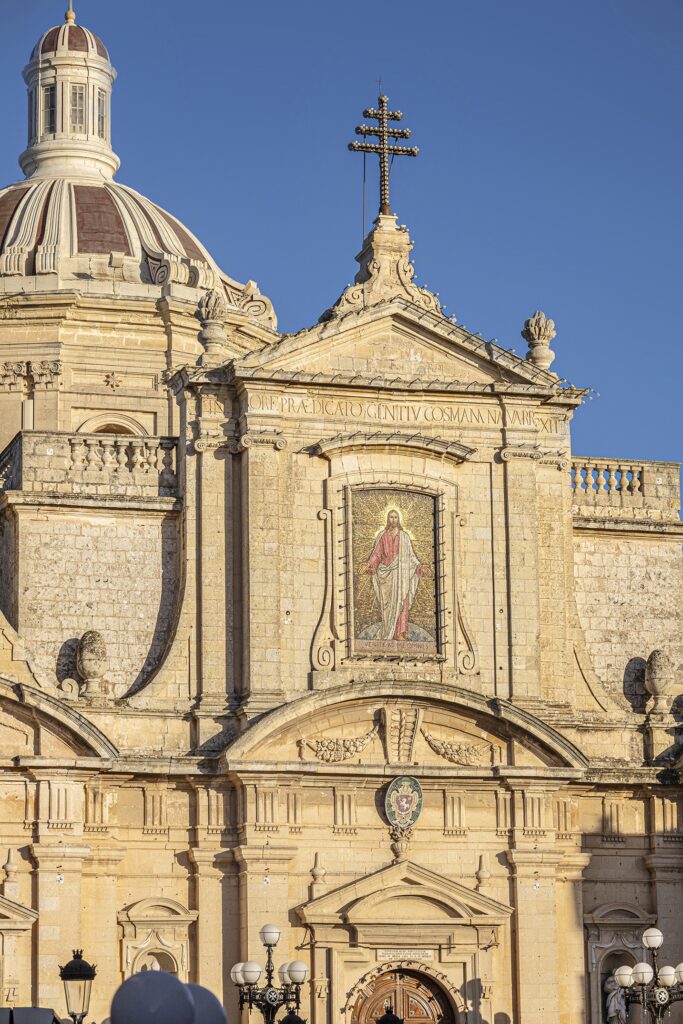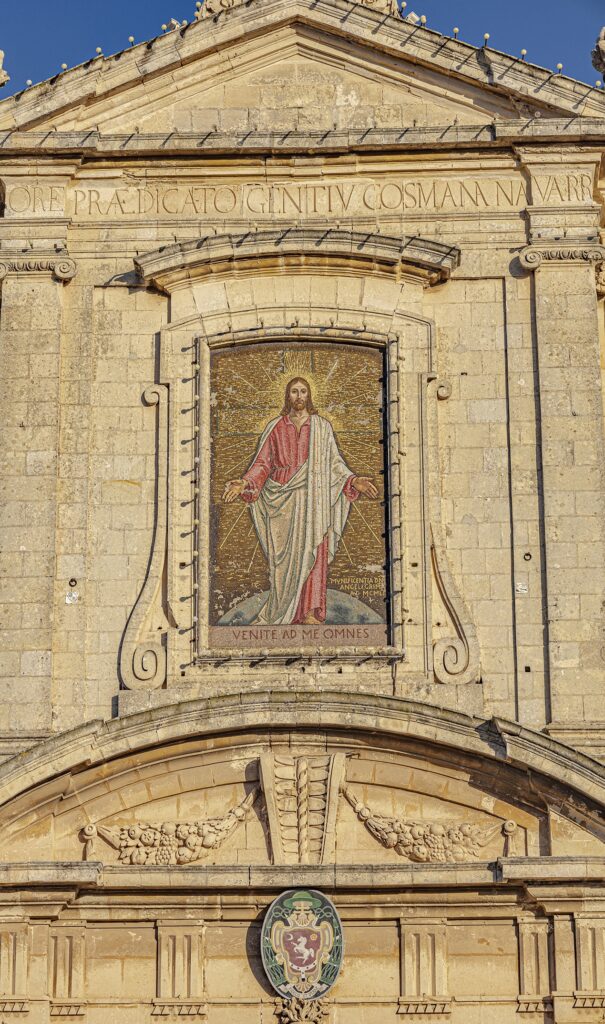
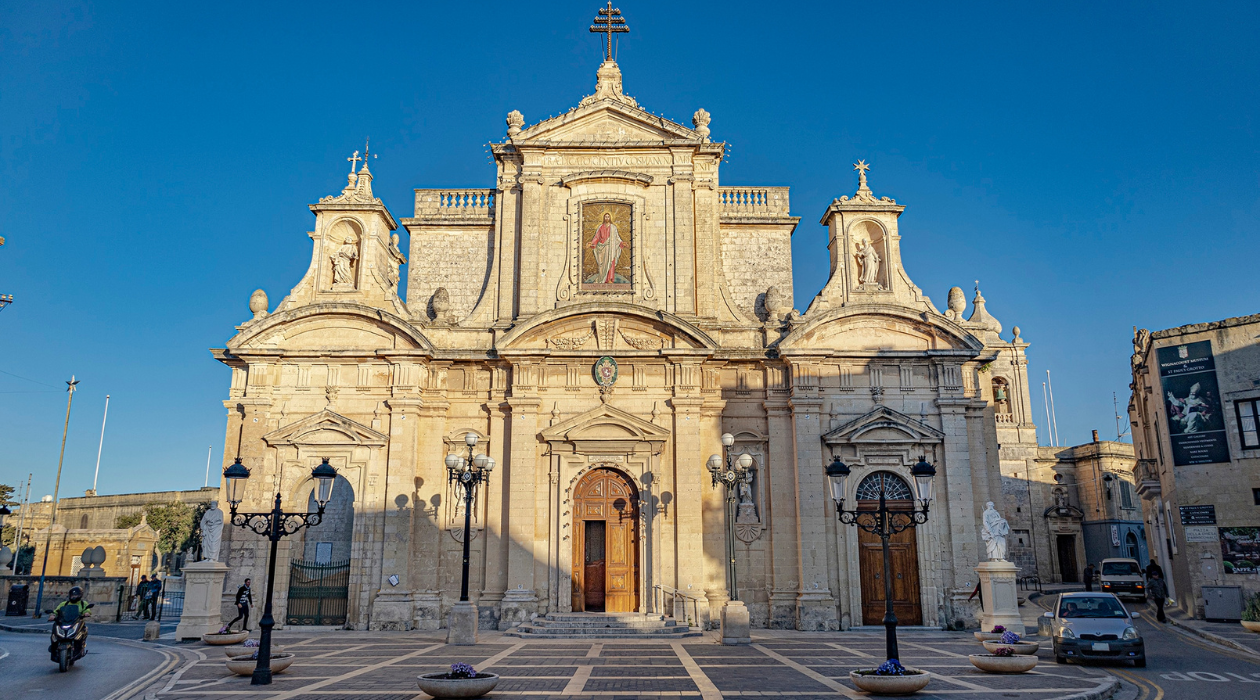
The parish church of San Paolo in Rabat was built between 1653 and 1683 according to the plans of the Italian architect Francesco Buonamici (1596–1677) and, after 1664, by the Maltese architect Lorenzo Gafa’ (1639–1703). The church was constructed over an earlier 15th-century building. Its Baroque design also had to accommodate another church dedicated to Saint Publius on the left, in such a way that it would not overshadow the smaller one, which belonged to the Order of Saint John.
History, Art, and Restoration of the St. Paul’s Complex in Rabat
The Church of St. Paul is part of an important religious complex that includes the church, the Grotto of St. Paul, and adjacent historical spaces. The façade, with its innovative design, achieves a unified composition that connects the ancient sanctuary of the Grotto and the adjoining cemetery with the new church. Its three identical portals symbolize the equal significance of these sacred places, while two statues of St. Peter and St. Paul, made in 1726, adorn the parvis alongside the consecration plaque.
The Grotto is traditionally recognized as the place where St. Paul is believed to have stayed during his time in Malta and has been a center of Christian devotion since the early centuries. Grand Master Alof de Wignacourt promoted the establishment of a collegiate church at this site, reinforcing its spiritual significance. The complex also includes an early Christian catacomb with tombs and an agape table, as well as a 17th-century crypt with chapels dedicated to St. Paul, St. Luke, and St. Tryphon.
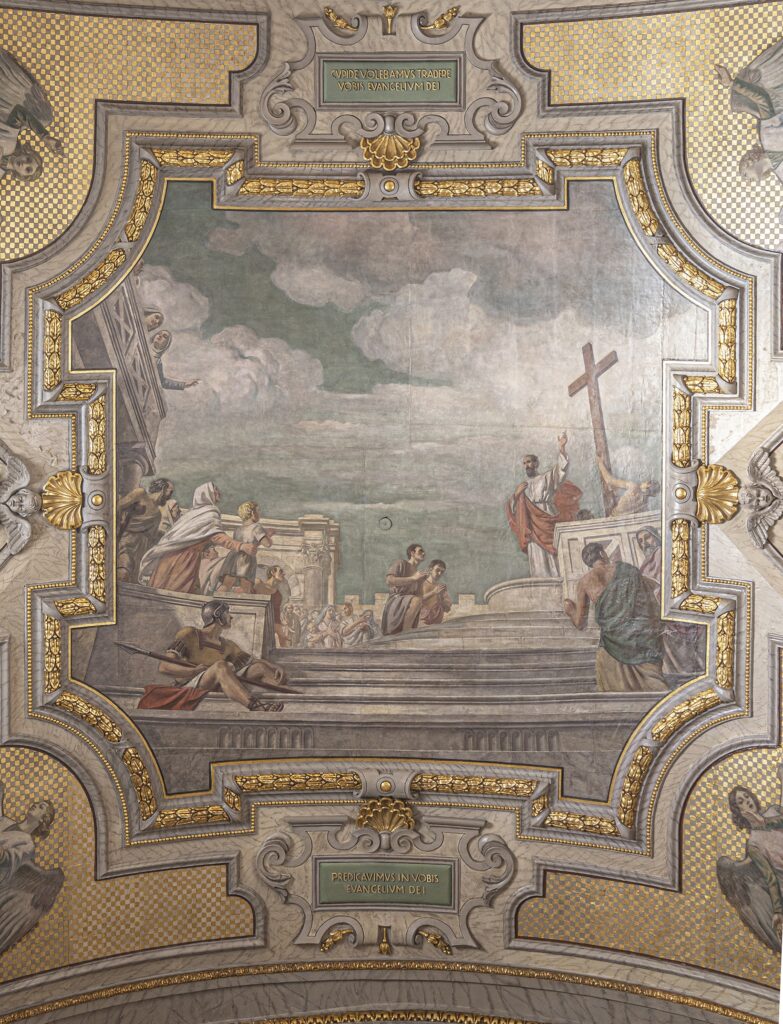
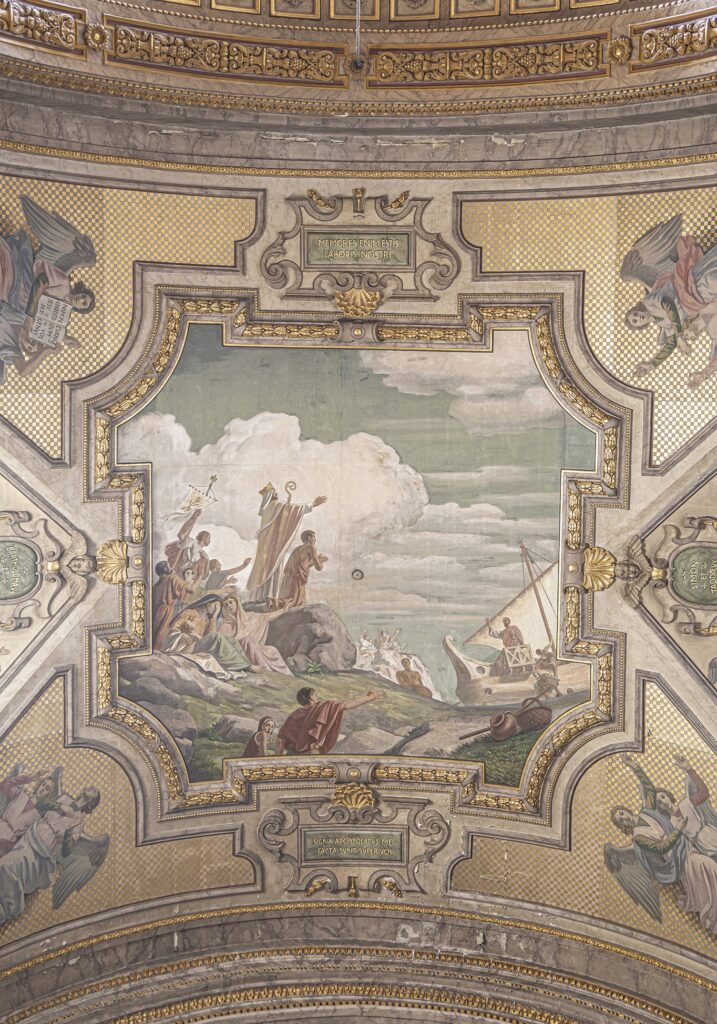
Inside, several works of art stand out. A modern painting on the vault, created after 1935 by Eliodoro Coccoli, depicts St. Paul preaching to a crowd, dressed in the traditional colors of Malta. The scene is set in a Roman-style city and is accompanied by the Latin inscription PREDICAVIMUS IN VOBIS EVANGELIUM DEI (“Hemos predicado el Evangelio de Dios entre vosotros”), está enmarcada por un retablo de piedra tallada con ángeles que dirigen la mirada hacia lo alto.
In the left transept stands the independent bell tower, whose main bell was cast in 1755 by John Warner. After the devastating earthquake of 1923, which caused the collapse of domes and roofs, architect Robert Galea oversaw the reconstruction, incorporating a lantern into the dome.
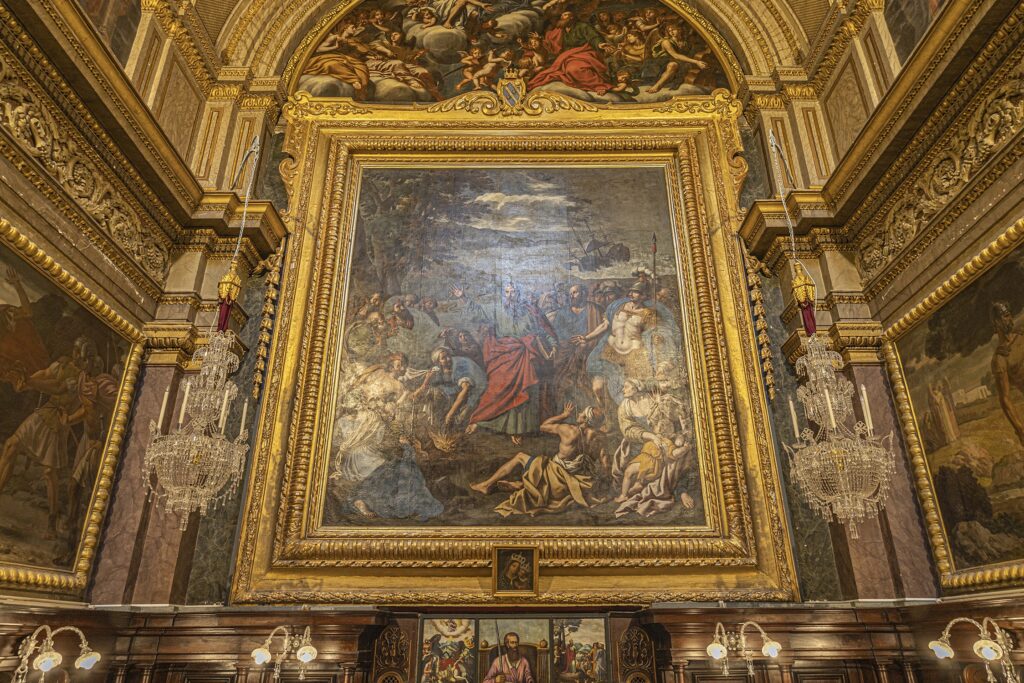
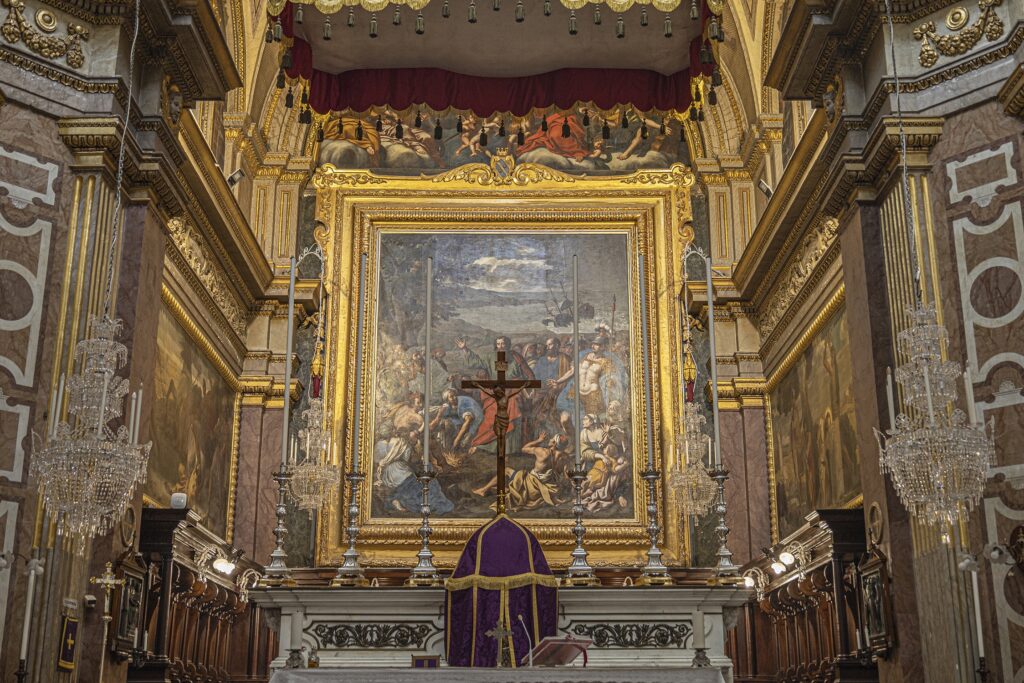
The church’s titular painting is The Shipwreck of St. Paul in MaltaCreated in 1678 by the Maltese artist Stefano Erardi, the work depicts the saint shaking off the viper after the shipwreck, while onlookers watch in amazement and a ship sinks in the background. This interpretation revisits a theme previously addressed by Matteo Perez d’Aleccio in the previous century.
A project co-financed by the European Union enabled conservation work to halt the deterioration caused by moisture, salts, and biological agents. Thanks to these stabilization and cleaning interventions, the preservation and future enjoyment of this valuable historical and artistic heritage at the heart of the community are ensured.