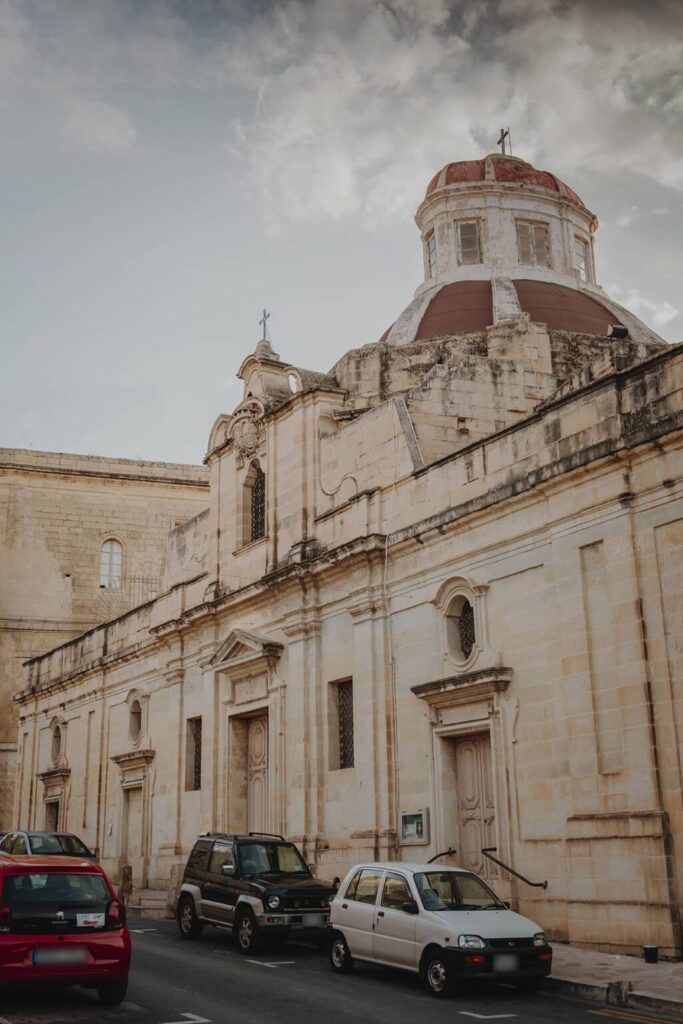
The design of St. Joseph’s Church (St. Thomas Churchis a work of Neoclassical style with Baroque elements, having been reconstructed in its current form around 1610under the patronage of Bishop Vincenzo Labini. Situated in the Santa Margherita area of Cospicua , this church forms an integral part of the facade of the Conservatory, an institution originally founded in 1726 to provide education and shelter for orphaned or underprivileged girls. Unlike free-standing churches, this temple stands out for being architecturally merged with the conservatory building, sharing a limestone facade that unifies religious and social functions.
Education and Charity: St. Joseph’s Legacy in Bormla
St. Joseph’s Church represents the historical commitment of the Three Cities to social welfare. For over a century, the complex was managed by the Sisters of St. Joseph of the Apparition, who turned this site into a benchmark for moral and civic education for the population of Cospicua. During World War II, due to its solid construction and strategic location near the defensive lines, the building served as a vital support point for the community affected by the bombings. Its architecture, featuring a bell-cot (espadaña) and a portal framed by pilasters, is an example of the sobriety and elegance that Bishops Labini and Mattei imposed on ecclesiastical constructions in the late 18th century.
The interior of the church is noted for its intimate scale and its atmosphere of serenity, designed for the prayer of the religious community and the students of the center. The centerpiece is the altar dedicated to St. Joseph, which historically housed a titular image of great local devotion. The interior design, though simpler than that of the grand collegiate churches, features decorative stone details that demonstrate the mastery of Maltese craftsmen of the period. Following the conservatory's closure as a school and its subsequent transformation into a home for the elderly, the church has regained its role as a spiritual center for the residents and the surrounding neighborhood.
Beyond its artistic value, the complex is a symbol of the continuity of charitable institutions in Malta. The building's facade, bearing the coats of arms of the bishops who funded its construction, serves as a reminder of the role the Church played in the educational development of Cospicua. After being restored to adapt to its new social functions, the St. Joseph complex remains a fundamental landmark in Bormla’s urban landscape. Consecrated as a sanctuary of charity and faith, it is an essential piece for understanding the history of social assistance in the fortified cities of the Grand Harbour.